All works and pictures © Copyright 1985--2020 by the author. All rights reserved.


A Portrait of Annie


A black and white Polaroid, circa 1964. A gaggle of young white boys stand at one end of a kitchen table, fourth-wall style. The youngest is a toddler in a high chair. The eldest is perhaps 8 or 9, with a gap-toothed smile borne of his assurance that he rules this particular roost. A birthday cake commands the foreground, its candles alight.

The kitchen lights are turned off, for the spectacle of the candles. The flickering flames overwhelm the camera’s automatic exposure sensor in the darkened room, forcing all else into shadows. The shining, happy boys in the foreground are overexposed against the inky background. Looking more carefully reveals a figure in the darkness behind the boys, a specter from out of the noir, a young woman whose skin tone blends into the caliginous margins of the room.

My father kept a family photo album with hundreds of pictures from our childhood, but this is the only photograph with Annie, the black maid who lived with us for three years.

* * *

We were not the wealthy people one usually associates with having live-in help. We were strictly middle-class, living in a middle-class neighborhood, in the middle-class white enclave of East Meadow, Long Island. But incongruously we had a black maid living in our basement. This happenstance came about because grandpa Abe came to the house one day to find his pregnant daughter-in-law scrubbing the kitchen floor.

Abe Gold came from modest beginnings. His father, Davies, was an artillery officer in Czar Nicholas II’s army. He was kicked out of the military for the temerity of being Jewish at a time when being Jewish was an increasingly unpopular thing to be across all of Europe. The rioting, burning, looting, and raping of Jewish towns in the pogroms of late 19th century Russia sent the Gold family aflight for a safer haven. Delivered via steerage-class on a steamship out of England, they arrived in fin de siècle Manhattan to the grandeur of a two-room, cold-water flat on the Lower East Side. The six children shared a single bed, with the cacophony of push-cart merchants, horse-drawn drayage, and the multilingual babble of white immigrant New York a constant din below their window.

Abe grew to be a young man with natural skills as a carpenter. He became engaged during the Roaring Twenties to a telephone operator named Ruth from Kew Gardens. Ruth loaned Abe $400 to start Queens Flooring Company. They married, and Abe provided a decent living for them by installing and repairing hardwood floors throughout Brooklyn and Queens. They bought a house in Richmond Hill, not too far from Ruth’s parents, and soon had two boys.

Abe suspended his company during World War II to work for a defense contractor. By the late 1940s his re-started company had a handful of employees and they were installing much of the oak flooring in the ticky-tacky houses of America’s first modern suburb, Levittown, Long Island. These tract homes were meant to help alleviate the housing shortage for the millions of soldiers returning from war, and were available for sale only to veterans—that is, white veterans. By the mid-1950s, Abe’s two boys had come to work for him, gotten married, and moved out to Long Island themselves.

In the 60 years between getting chased out of Mother Russia by violent mobs of anti-Semitic Cossacks, and achieving a comfortable life on Long Island as a successful burgher and full-blown member of the bourgeoisie, Abe acquired a clutch-my-pearls noblesse that belied his scrappy immigrant origins on the Lower East Side. Seeing the mother of his only grandchild—now pregnant with his second grandchild—scrubbing a kitchen floor on her hands-and-knees disturbed Abe enough to give his son a raise so they could afford to hire a maid.

* * *

We had a succession of daytime maids—all of them black—in the late 1950s, as our mom bore three boys from 1956 to 1959. The maids came through a county employment agency in Hempstead, which is one of the few hamlets on Long Island that wasn’t strictly redlined—everyone knew that Hempstead was where we kept the black people in central Nassau County[1]. A maid would arrive each weekday morning, usually by bus, and was responsible for keeping the house clean, while mom tended to the cooking and us boys. The maids came at a cost of a dollar an hour, the minimum wage at the time, the equivalent of $9.31 in 2020.

This situation changed in 1961 when mom became pregnant with her fourth child. Exhausted from wrangling three rambunctious boys under the age of 6, my parents decided they needed live-in help.

The first of these was Malvina. A few weeks into her residency in our home, she was left to babysit the three of us one Saturday night so mom and dad could have an evening out. As Malvina later told them, she’d heard a suspicious noise outside, grabbed my mother’s good chef knife, and went out to investigate. Malvina was sent packing the next day.

What followed over the next few months was a series of black maids who Did Not Live Up To Mother’s Standards for one reason or another, but which mostly have their roots in casual racism. Finally, in desperation, with a child burgeoning ever closer to its birthdate, mom placed a call to her cousin Frieda in South Carolina to ask for her help in finding someone. “Send me someone honest,” my mother begged of Frieda. The choice of the word ‘honest’ unpacks itself in this context.

Cousin Frieda lived in the town of Latta, where her family owned Kornbluth’s Department Store, selling mostly clothes, some furniture, small appliances, and housewares. Latta was a town of just under two-thousand people at the time. It made national news in 2016 when the mayor had Police Chief Crystal Moore fired for being openly lesbian. One doesn’t have to wonder much how the town of Latta treated people in the 1960s who were openly black.

It’s hard to fathom the audaciousness of a white woman making a phone call to someone in the Deep South to order up a bespoke black maid, as casually as one might order a custom settee from a Carolina furniture shop. Apparently the procurement of southern black maids was a service Cousin Frieda had provided for mom’s older sisters as well, a decade or more earlier. It feels so cringey, looking in 2020’s rearview mirror, but the benefits and detriments of this overground railroad are questions we can only guess at for the young women who made this journey.

 Annie, a girl of nineteen or twenty, may have worked for Kornbluth’s, or was otherwise already known to Cousin Frieda—it’s easy to imagine how most everyone knew everyone else in a town that was smaller than my high school by a thousand people. The means and conversation by which Cousin Frieda convinced Annie to leave Latta, South Carolina is unknown. Perhaps it was enticing and exotic to Annie. Perhaps jobs were hard to come by in the small village. Maybe she espied escape from the unrelenting grind of Jim Crow. Whatever the impetus, young Annie packed up her scant belongings in a single suitcase and was put on a train to New York, with my parents having paid her fare.

That’s how Annie—a young black women whose forebears had arrived five or ten generations earlier, by way of all the horrors of the Middle Passage and beyond—came to work as a live-in maid for a white, Jewish, middle-class family in America, who had been here but for a single generation.

* * *

Annie lived with us for almost three years, doing our house cleaning, clothes washing, and occasional babysitting. I have one vivid memory of her, when there was an incident a couple of years into her tenure. I was four-years-old, and had spent the morning helping mom make cookies. I was having some of them at the kitchen table while Annie cleaned up after us. Suddenly the milk-glass mixing bowl from the Mixmaster slipped from Annie’s soapy hands, shattering in the sink and spraying some shrapnel to the floor. Not trusting either of us to be safe from the shards, mom brusquely ordered Annie and me to go sit at the top of the basement stairs while she cleaned up the broken glass.

As we obediently sat at the top step, I noticed Annie’s hands were still wet from dish washing. I don’t know why, but for some reason I reached out to hold her damp hand. Maybe it was because we had both just been well-meaningly yelled at by my mom.

I remember Annie’s hand, how rough it was. Even through the dampness I remember feeling callouses on her fingers, callouses earned from doing housework for our family.

But then—

But then I noticed the color of her hands for the very first time. And then I looked at her face. Something clicked in my four-year-old brain. Annie was … different. I didn’t understand this difference. Why was she different? Because the world and its constructs had not yet been imprinted on my young psyche, I did what four-year-olds do—I asked the question.

“Why is your skin dark?”

She smiled at me, as only one can at a child who cannot possibly comprehend how badly we have fucked up this world.

“The sun made me this way,” she assured me in her Carolina drawl, “I spent too much time in the sun when I was a little girl.”

And being four, I accepted that answer.

* * *

Annie’s service to our family came to an embarrassingly bourgeois end when my father bought a little red speedboat in 1964. We could not, he decided, afford both a maid and a boat; and a boat, is what he wanted. Each week, Annie had been paid $25 cash, plus room and board, for five-and-a-half days of work. She would sometimes take the train to Brooklyn on her day off to visit with a man she knew, we know not from where. When she moved out, Annie had left behind some of her clothes and a few possessions. She returned some months later to retrieve them, with a man in tow. She introduced him as her husband, and that’s the last we know of Annie’s life after serving as our live-in maid for three years.

I won’t ever know why Annie felt compelled to answer me the way she had that day at the top of the stairs. Maybe she was well-read and was slyly alluding to the Langston Hughes’ poem, or perhaps she knew of Lorraine Hansberrry’s Raisin in the Sun. I’ve always wished, once I knew better, that she’d responded differently. “There are black people in this world, little man,” she might have said to me, “it’s time enough you know that, and what’s been done to us—is still being done to us—because of it.

There were plenty of good reasons in 1964 for her to not tell me that simple truth, all of them hinging on zeitgeist and racism. Whatever her thinking was, Annie choose to not edify a little white boy that day, a little white boy who had never before noticed any difference in people until that very moment.

I regret that we do not know how Annie fared for her time with us, or her time after. Our family knew nothing of Annie’s inner life, or her experience, or her dreams, and that is a sort of crime against someone who devoted three years of her life to us for meager recompense. We are left only a memory, and a photo with her standing in the background of our family. All that remains for us is to hope that Annie went on to have a good life that was full and happy, with many photographs of herself standing in the foreground.


[1] https://projects.newsday.com/long-island/real-estate-agents-investigation/

Bar Mitzvah Blues (sung to the tune of Bell Bottom Blues)

So Gawker had a contest to see see who had the most embarrassing Bar Mitzvah pictures. I knew I was a shoo-in to win. The sheer volume of cheesy pictures from that day would guarantee my victory.

The year was 1973. Richard Nixon had just started his second term but all anyone could talk about was Watergate (the bestest 'Gate' of all the gates). The Vietnam War still raged. Hippies were starting to fade into the woods. Pink Floyd's Dark Side of the Moon and Led Zeppelin's Houses of the Holy had just been released (check out Jimmy Page's bitchin' double guitar, though one of them is a 12-string, so really, it's like a triple guitar, bitches).

And then there was little Jonny Gold, 13 years old and already an accomplished stoner, who was about to become a man.


Why am I carving the corned beef? Fuck if I know. Why were there cherry-stuffed pineapple rings on top of it? Fuck if I know.


My brother Richard lighting a big fat spliff for me. Man, I could roll the fattest joints.


This is the cousins table. Let's start with Jew 'fro, back row, second from the right. That's cousin Burton who is now an evangelical christian and divorced from his born-again wife (not the woman he's standing next to, I don't know who that is). To the left of Burton, with the porn star mustache, is Clyde (not kidding), married to my cousin Jenny, next to him. Several years earlier, my adult cousin Jenny, raised in Colombia, SC, was so bereft of accurate information about sex that she had to ask her pre-adolescent NY cousins what '69' was.

Long divorced from Jenny, Clyde is now in prison for the same crime that catholic priests never seem to go to prison for.

To the left of Jenny is Richard's girlfriend of the week. I did not know Richard had recently (like, the day before) changed girlfriends and I greeted this one by the name of the previous one. Oops.

The Jew 'fro in the center of the bottom row is cousin Larry, the family cautionary tale before I took over that role. Larry was directionless in his youth, dropped out of school, held a series of meaningless jobs, did what he wanted. At one point I think he was an elevator operator (yes kids, it's true that was once a profession, just like a cooper or a typesetter).

Throughout my lackluster academic career, I was often asked, "Do you want to end up like cousin Larry, unemployed? in Greenland?" I may be misremembering the bit about Greenland, but you get the point. And I did follow somewhat in Larry's footsteps. I dropped out of school and I held a series of meaningless jobs. I did what I wanted. I bought a motorcycle and rode it cross country. I married a shiksa (that's yiddish for 'female pork eater').


Cousin Larry is now a doctor. I now own two restaurants. My two older brothers, who clearly did not choose to be like cousin Larry, both have multiple college degrees, are underemployed, underpaid, and unhappy. So, kids, when someone asks you if you want to be like cousin Larry, smile and say, 'Yes, please."


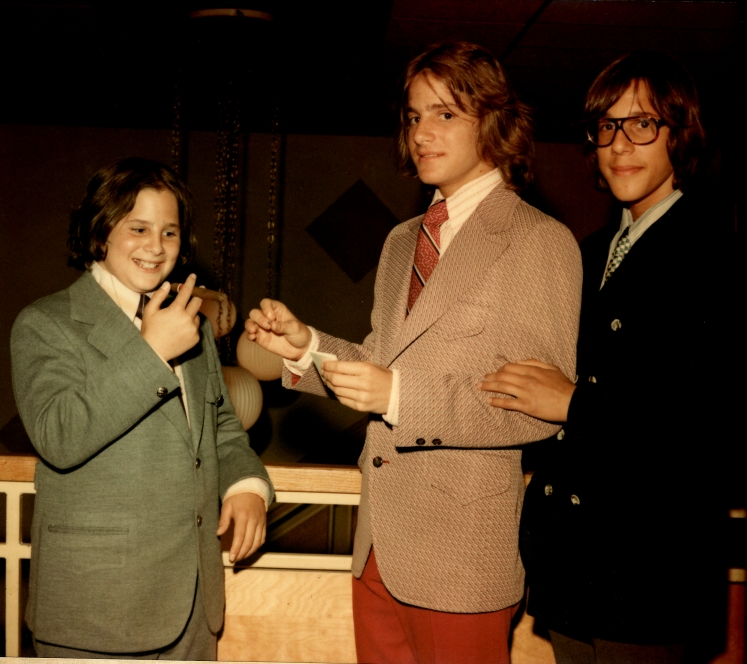
Why is my friend trying to give me a hot foot? Fuck if I know. Who's the douche-nozzle giving me bunny ears? Some Carolina cousin whom I'd never met before. Also, dig the ginger suede shoes and ginger tie on the ginger kid on the right. He be stylin'.


Here I am getting kissed by the two hottest girls from Barnum Woods Elementary School, class of '72. Lana, on the right, is looking askance at the camera, and is clearly mortified that there will be photographic evidence of this moment. She should be, she is wearing a giant bandana as a floor length dress.


Why is my brother Michael staring straight ahead like some weirdo while the rest of the family participates in this staged, yet touching, scene? Because Michael is odd. He has always been odd and will always be odd. It's why we keep him around.


Rockin' sideburns, Harold! Also note the stylin' jacket, which in just a few short years would morph into a leisure suit. Thanks for the gin, Dad, although I couldn't help but notice that I didn't get the good stuff. Where's the Tanqueray?


I have little doubt that the sawbuck my dad is giving me is the last of his money; that ten'er is the equivalent of over $50 today and the several thousand dollar cost of the party would be about $15k today. And he had to pay for four of these shindigs.


This inscrutable moment is my Rosebud. It haunts my waking moments, it darkens my dreams. I will be going about my day, minding my business and then suddenly the image of this boot will appear before my mind's eye like a cognitive non-sequitur. There is no escape from it. The boot has no inherent meaning in and of itself but it's unknowable metaphorical significance casts a shadow upon my entire existence. I am utterly alone and without purpose, like a boot that has no foot.

There is water at the bottom of the ocean

clicking the pictures will open them up full size in a new tab, and you definitely want to see them full size


You spent the morning scuba diving off Norman Island through Seussian seascapes


encountering creatures both weird and wonderful.


You sailed to Little Harbor in the afternoon where you enjoyed a fine repast with your shipmates, kindred spirits all.

You hoisted glasses of rum in honor of Jackie and Hannah and Lisa and Serenity and Janice who all left this world much too soon.

You watched the sun set over Tortola.


You had conversations about everything and nothing. You joked, you laughed, you silently toasted the gods with more rum lest they be jealous.

You watched twilight fade. You watched sidereal light poke holes in the gathering blackness of the night.


You smiled as a gentle breeze blew off the remaining heat of the day. You listened to Bag's Groove playing softly in the cabin while cicadas on the nearby shore joined in on percussion and waves lapped the beach.

You closed your eyes and breathed in deeply the whole world. You realized that the key to the rest of your days is to feel this way every day no matter what, except for the part where your butt is still stinging from the tattoo:


The rest of our adventure can be seen here on Flickr.

COMING SOON: Belize 2012!

Walking in Paris - Street Sign Edition

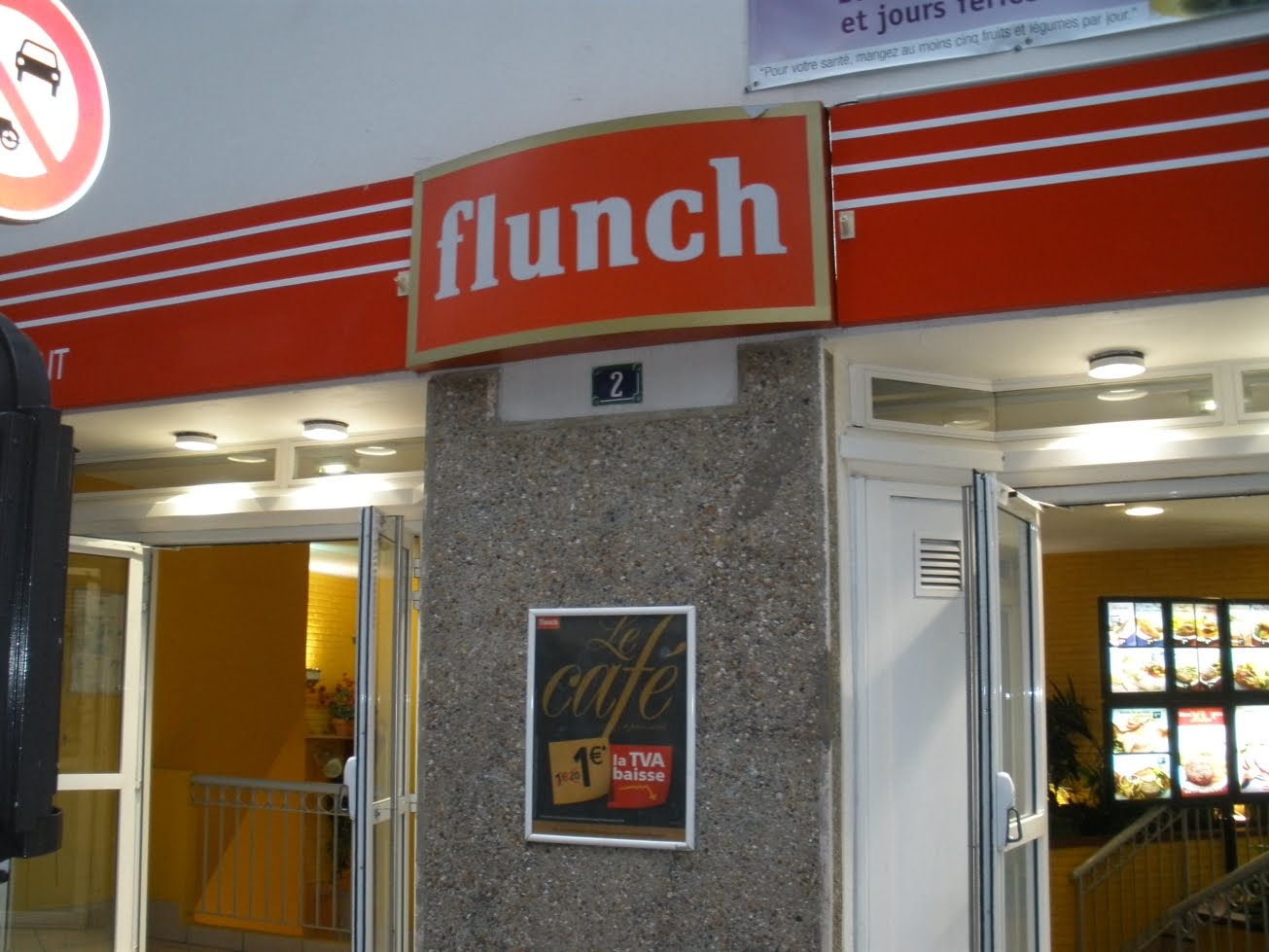
I have been a font and design slut since my days as a typographer. Well executed typography gives me an aesthetic erection (not to be confused with a culinary boner). Paris, not surprisingly, has an abundance of beautiful signs.

Some of the signs I've included are here only for their content and/or snarky commentary, not necessarily because of their intrinsic design appeal.


Clicking on the pictures will open them up in a new tab.

Sign on a building in the Latin Quarter. Verlaine died here, probably of a broken heart (but the drugs and absinthe may have helped). This was also Hemingway's first apartment.


Found in the window of a tattoo shop and it is the very same image I have tattooed on my chest.


Not a sign, but a French Tardis.


We found an understated use of neon in old Paris, not everything blares out like the Vegas Strip as signs tend to do in the States. This tobacconist had a delightful double cone wrapped in a spiral of neon.


The optometrist sign was perfect.


In movable type, each character is called a sort. Here is a storefront sign in Montmartre that nearly broke my typographer's heart as it is made up of antique wooden sorts. The 'T' and the 'A' are about 20 inches tall.


Run left if you are on fire..


...otherwise go right.


In printing, recto and verso mean front and reverse, to indicate printing on both sides. In French, the phrase also means two sides of the same thing.


It's always nice when the name of place tells you exactly what the place is; this is a strip club down the street from the Moulin Rouge:


and this says...


...'PUSH' in French, you pervert.


This is the original typeface designed for the Paris subway in 1902. I would marry this font if I could.


Apparently, you can't get a martini at the pharmacy, despite appearances to the contrary:


A hardware store, specializing in paint:


While we tend to think of hurling as something we do after the pub, it is also a sport from Ireland, which closely resembles polo without the horses.. If you look closely at the front of the awning, you will note that the Hurling Pub also has a 'hoegaarden,' insert your own pun here.


All this time I thought that song was just a bad metaphor:


They must get some kick ass storms:


Yes, friction can be dangerous, as the sign announces, but without friction we would not have had fire or procreation. In fact, I imagine it was not terribly long after the first fire was built that a woman sidled up to the fire maker to show her appreciation.

NB to all the femistas out there: Yes, it was probably a woman who first made fire and a man took credit for it. I'm sorry.


The French are kind and generous: free rain coats


Even the French are not immune to the lure of fast food:


Le Boudubar (cheesy youtube ad here!) Alas we did not have time to go in, perhaps next visit.


This sign is around the block from Notre Dame. Given the proximity to the famous cathedral, I can only assume it means that you should not let your children go off with clergymen. Thank you, French people, for keeping our children safe!


World's best bathroom sign, found in a bar around the corner from our hotel:


Printing Porn

Thirty years ago my career began with a stint as a typographer, manipulating computer code to make a $200,000 photographic printer spit out galleys of type which would soon become books and magazines: The Whole Rat Catalog, The Professional Wine Reference, Vinyl Leaves, Business Week, Working Woman, Architectural Record, Aviation Week, Coal News (it all can't be glamorous). Parenthetically, can you imagine if someone walked into a publisher's office and proposed a new magazine called Working Man?

I was proud to be a member of an industry which had transformed the world so long ago and continues to have an impact today. Five hundred years ago 99% of the population lived and died without having read a single word in their entire lives. As you go through your day today, try to go 10 minutes without reading something. Benjamin Franklin, who had many diverse talents, began his will with the humble declaration, "I, Benjamin Franklin, of Philadelphia, printer..."

By the late 1980s PostScript and Quark Xpress reduced my well-paying skill set to about $10 bucks an hour and I unschooled myself into a new career that paid better.

As more of our printing is done with electrons, I think we tend to give less thought to the art of printing and where ink comes from and how printing has impacted the world and what it has led to today.


I sometimes miss my old career. While I enjoy being a purveyor of good food and coffee, I also really enjoyed designing type and page layouts. There was a precision to those skills that food service does not entail. On the other hand sometimes everything comes full circle and those old printing skills of mine may come in handy once again, re-purposed for food and coffee in ways no one could have predicted.